Showing posts with label May 17. Show all posts

Thursday, 17 May 2018

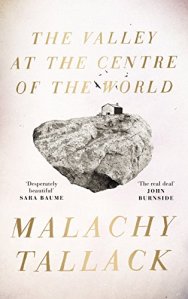
The Valley at the Centre of the World – Malachy Tallack

515v8uhvqgl

Description
‘The thing he felt ending was not just one person, or even one generation; it was older, and had, in truth, been ending for a long time . . . It was a chain of stories clinging to stories, of love clinging to love. It was an inheritance he did not know how to pass on.’

Shetland: a place of sheep and soil, of harsh weather, close ties and an age-old way of life. A place where David has lived all his life, like his father and grandfather before him, but where he abides only in the present moment. A place where Sandy, a newcomer but already a crofter, may have finally found a home. A place that Alice has fled to after the death of her husband.

But times do change – island inhabitants die, or move away, and David worries that no young families will take over the chain of stories and care that this valley has always needed, while others wonder if it was ever truly theirs to join. In the wind and sun and storms from the Atlantic, these islanders must decide: what is left of us when the day’s work is done, the children grown, and all our choices have been made?

*********

The Valley at the Centre of the World was on my wish list so I was delighted when the publisher approved me to download a preview copy.

I have to confess.  I have an interest here.  I love visiting Shetland.  My grandmother was born and brought up in Dunrossness and although the family moved to mainland Scotland in the 1920s when she was in her teens, I still have relatives who live in Shetland.

I found the book an enjoyable and easy read about the inhabitants of  one remote valley in Shetland over the course of almost a year – the ones who were rooted there, the ones who arrived and left, the ones who arrived and stayed a while.  While it is not a fast, exciting read I liked the style and enjoyed reading about the various characters and their interactions.  For me there was a sort of familiarity with the people and place.  There is just the right amount of back story for each of the characters too.

It’s just a fact that there are some who can’t wait to leave Shetland and others who can’t imagine wanting to settle anywhere else.  My grandmother was one of those who went ‘hame’ to Shetland for her holidays most years until she was well into her 80s.

Some of the dialogue is written in Shetland dialect but there is a helpful glossary at the beginning of the book.  I loved the lines written in dialect.  It brought these characters to  life.  I could picture the scenes and the Shetland humour comes through too.  I didn’t find it difficult to understand but perhaps I had the advantage of growing up listening to my great grandfather, my grandmother and her eight sisters.  Don’t let the dialect parts put you off.  I think it makes the characters seem more real.

[My thanks to NetGalley and Canongate Books for providing me with a digital review copy].

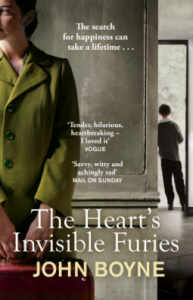
The Heart’s Invisible Furies – John Boyne


cover127032-medium

Forced to flee the scandal brewing in her hometown, Catherine Goggin finds herself pregnant and alone, in search of a new life at just sixteen. She knows she has no choice but to believe that the nun she entrusts her child to will find him a better life.

Cyril Avery is not a real Avery, or so his parents are constantly reminding him. Adopted as a baby, he’s never quite felt at home with the family that treats him more as a curious pet than a son. But it is all he has ever known.

And so begins one man’s desperate search to find his place in the world. Unspooling and unseeing, Cyril is a misguided, heart-breaking, heartbroken fool. Buffeted by the harsh winds of circumstance towards the one thing that might save him from himself, but when opportunity knocks, will he have the courage, finally, take it?

*********

I’m not sure where to start with my review of The Heart’s Invisible Furies to do this wonderful book justice. I loved it, right from the start, even before Cyril Avery officially appears (although he is the narrator in the story). It was a delight to read. There is a wonderful kind of rhythm to the writing. John Boyne’s characters are so vivid and real. I could see them. I could hear them speak. I felt as if I knew them.

It’s 1945, West Cork, Ireland. The book opens with a young girl, 16 year old Catherine Goggin, being denounced by the priest in front of the congregation at Sunday mass and cast out by Father Monroe and her family. Her crime? Being pregnant, unmarried and refusing to name the father. She’s told to go and never return and so leaves for Dublin where she manages to get a place to stay and a job and later gives birth to a baby boy.

Cyril is adopted by a rather eccentric couple who had no children of their own. They are not bad people but Cyril grows up, often being left to fend for himself and there isn’t much affection shown to him. Charles Avery would always make it clear that Cyril was adopted and not a real Avery.
He realises he is not like other boys. He has no interest in girls and even at the age of 7 he becomes secretly obsessed by his friend Julian who had no idea of Cyril’s infatuation.

I felt lots of different emotions – anger at the hypocrisy and small mindedness of the church and state, and sad at Cyril’s plight – he had quite an unconventional upbringing and he seemed lonely and in need of a friend. He just wanted to live his life but of course at the time it was a criminal offence to be homosexual. It’s horrific the way homosexuals were treated. But the story is also very funny and witty and a joy to read.

The book is divided into three parts and an epilogue: I Shame, II Exile and III Peace. It spans 70 years, moving from Dublin to Amsterdam where Cyril meets his future partner then later to New York where he has to face a terrible and unexpected tragedy. However during these 70 years Cyril and Catherine’s paths cross several times without either of them realising. It also took 70 years for Cyril to realise he is finally happy.

This has to be one of my favourite reads of the past year. It’s also a book I would be happy to read again and there aren’t too many of those.


Tuesday, 17 May 2016

Painting Without Paint - something completely different

51zc5fm9b7l-_sx384_bo1204203200_


Just for a change I’m not reviewing crime, romantic or contemporary fiction today.
I’m sure there are many tablet and iPad users out there who haven’t really considered drawing or painting with their tablet.  This is your opportunity to unleash your inner artist!  It’s amazing what you can do using free painting/drawing apps.

A few weeks ago Search Press sent me a copy of Painting Without Paint – Landscapes with your tablet by Matthew Palmer in exchange for a review. When the book arrived I was keen to get started.
This is well laid out book with good illustrations and clear explanations.  I spent a very enjoyable weekend trying some of the examples in the book and I felt I learned something useful.

Matthew Palmer starts by explaining what you need to Paint Without Paint (an iPad or an Android Tablet), painting tools (finger, rubber tipped stylus or brush tip stylus) and your preferred app. The instructions in the book are demonstrated on an iPad using the Brushes app (a free app).

I don’t have an iPad but that wasn’t really a problem. I use an Android tablet and the Brushes app isn’t available for android.  I tried Artrage for the first couple of exercises but ended up using Autodesk Sketchbook Pro. These are paid for apps but there is a free version of Sketchbook.   Matthew mentions a few of his favourite apps and gives their pros and cons.

I found the sections very helpful.  I really liked the section on Creating your brushes. Every app usually has a few preset brushes but you can alter these to give different effects and textures. He lists the settings for a default round brush and 9 other brushes. Each brush has a picture of the brushstroke and the tip plus the settings to get that particular brush. The clear explanations and illustrations meant that I was able to create something similar (but not identical) in the app I was using.

After reading the next section on colour basics I was ready to get started with the first couple of exercises. The exercises all have clear step by step instructions and good illustrations.

The next day I managed to borrow an iPad for the weekend and I downloaded the Brushes Redux app (free). I must confess I did find it easier as I could follow the instructions in the book and change the brush settings as directed. I began to understand what would happen when I tweaked the brush settings. That was a revelation. It also meant I got through the next couple of exercises fairly quickly.

However just as I was getting the hang of it I had to return the iPad. Even using it for a short time really helped when I went back to using the android tablet. I even tried a couple of simple paintings without reference to the book! I’ve included some of my first attempts with this review. They wouldn’t win any prizes but I had fun ‘painting’ them.

61fcl43cql-_sl256_ 61n9fv3nfcl-_sl256_ 61evwdfuy7l-_sl256_ 71v2thwfyzl-_sl256_ 61ciyk3yvul-_sl256_ 61hxbjrbxnl-_sl256_

I haven’t worked through the whole book. I’ve flicked through it and it looks really interesting. The next section is ‘Layers”. I know a little bit about them but have never really learned to use them properly. I’m looking forward to learning more.

The last section of the book builds on the simple earlier exercises and takes you step by step through four landscape paintings that combine the techniques featured earlier in the book.
The book is great value. It is packed with useful information and although I only got to page 57 of 128 pages, I’ve learned quite a lot.

Painting is one of my hobbies (acrylics and sometimes soft pastel). I get very messy. Digital art is different. You can take it anywhere. There is no mess! (With practice I might even improve).   I think it would also be a very useful and practical book for beginners.

Publisher:  Search Press